

 Keith Nallawalla
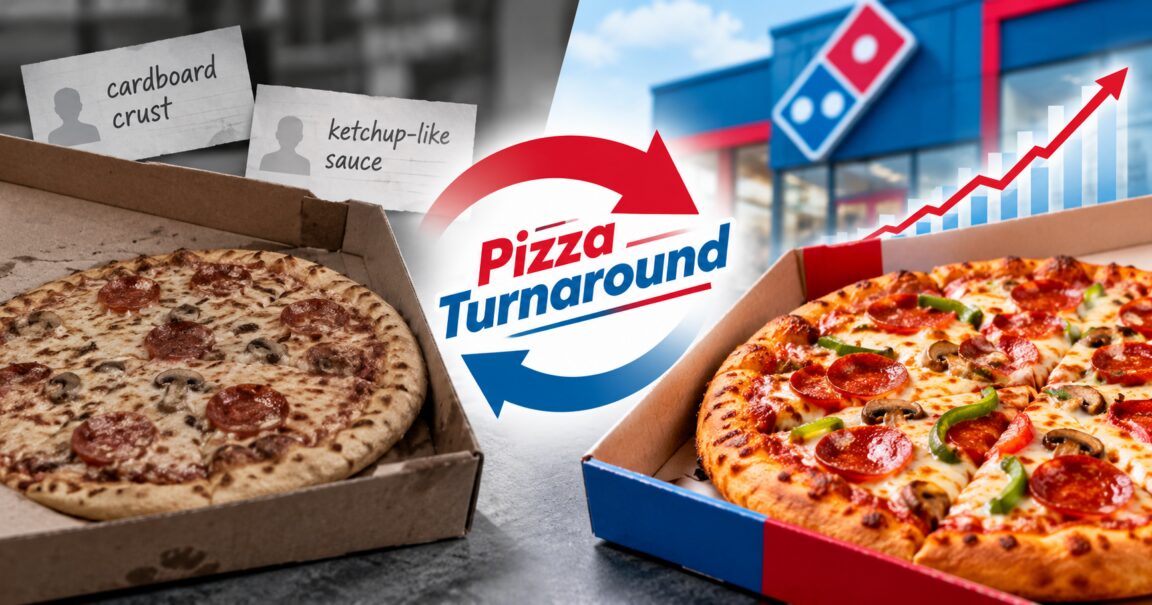
In 2009, Domino’s Pizza ran one of the boldest ad campaigns in food industry history, the Pizza Turnaround, built entirely around the company admitting, on camera, that its own pizza was bad. Quick disclosure since I’m writing this from Australia: everything below is about that American company, Domino’s Pizza Inc., not the Domino’s you’re ordering from on a Friday night here. Our local operator, Domino’s Pizza Enterprises, has been a separately owned, ASX-listed company since 2005, and licenses the name and system rather than being run by the same people. Same brand on the box, different company making the decisions, and for what it’s worth, my own experience of the local version has genuinely improved over the years. None of what follows is a comment on that business, it’s about the US parent brand and this one specific campaign.
Every other case worth studying here is a company reacting to something that happened to it. Domino’s is the rare one where the company started the crisis itself, on purpose, before anyone made it do so.
How bad Domino’s pizza actually was before the turnaround
By 2009, Domino’s had a real problem that had nothing to do with a single incident: the pizza itself. A Brand Keys survey ranked it dead last among national pizza chains on taste, tied with Chuck E. Cheese. Customer feedback, when the company actually went looking for it, used words like “cardboard” for the crust and compared the sauce to ketchup. The stock had fallen from around $19 to roughly $2.61. As CEO Patrick Doyle later put it, the company had built its whole brand around fast, reliable delivery, and had ended up serving “everyone in the world who wanted fast, convenient pizza,” while everyone who actually wanted a good pizza went elsewhere. This wasn’t a scandal. It was a slow, well documented decline that most companies would have tried to fix quietly while the marketing department kept talking about something else.
Inside the Pizza Turnaround campaign
Domino’s did the opposite. In December 2009, under then-president Patrick Doyle, the company launched what became known internally, and soon publicly, as the “Pizza Turnaround” campaign. The centrepiece was a documentary style advert built entirely around real, unscripted focus group footage of customers trashing the product, cut together with Domino’s own executives and chefs watching the criticism land. The campaign became known in the industry, somewhat inevitably, as the “Our Pizza Sucks” ads, a nickname Domino’s never used itself but never fought either.
Crucially, the admission wasn’t the whole strategy. It arrived at the same moment as an entirely reformulated crust, sauce and cheese, developed specifically in response to the criticism being aired. Domino’s wasn’t asking people to feel better about the old pizza. It was telling them the old pizza was gone. Doyle himself put it simply on camera: “There comes a time when you know you’ve gotta make a change.”
Did the Pizza Turnaround actually work
Same-store sales grew close to double digits within a year of the campaign launching, a genuinely rare result for a company that had just told its own customers their core product had been bad for years. Doyle was named CEO in March 2010, months after the campaign began. By 2011, Domino’s was named Chain of the Year by Pizza Today magazine. The stock, which had bottomed out around $2.61, went on to become one of the more remarkable long-run comebacks in American retail, split-adjusted gains that dwarf almost every other case in this series.
Why this is the hardest apology on the list
Every other example here involves a company admitting fault after getting caught. Domino’s admitted fault before anyone was forcing it to, about a problem that was entirely its own and entirely avoidable. That’s a harder sell internally than it sounds: it means telling your own franchisees, your own staff and your own shareholders that the thing you’ve been selling them for years wasn’t good enough, with no guarantee the fix will land. KFC could be funny about its shortage because nobody was hurt and the problem was temporary. Domino’s had to be honest about something closer to the bone: not an accident that happened to the company, but a standard the company had set for itself and quietly let slide for years.
There’s more on how the other “good” examples in this space handled their own version of this moment in [the wider roundup [LINK: The best and worst corporate apologies of the last 20 years]], if you haven’t already read it.