

 Keith Nallawalla
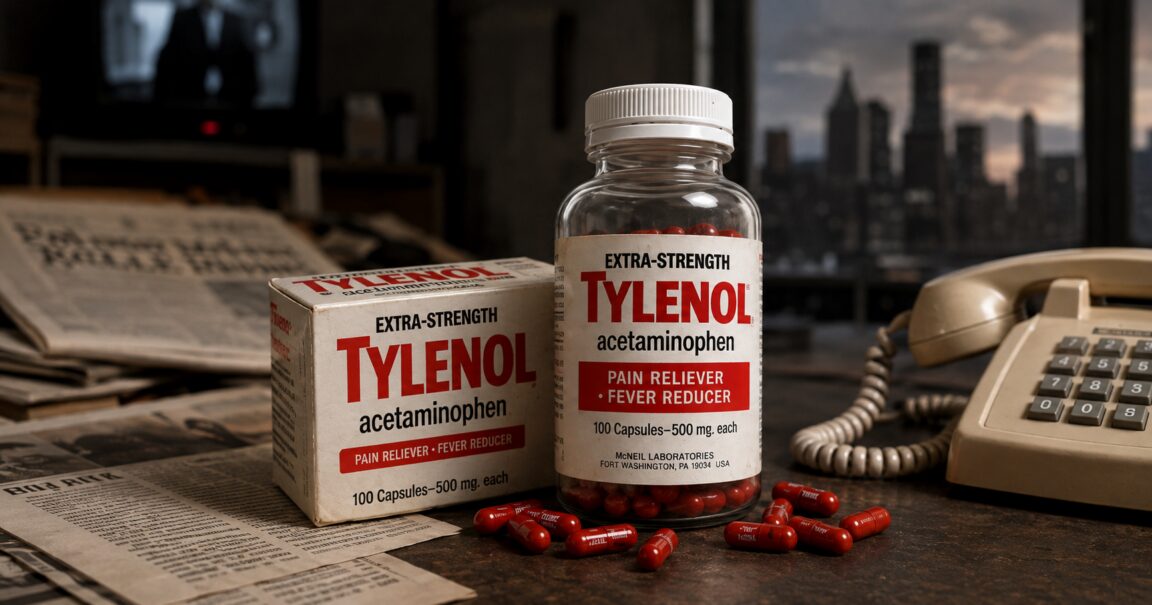
Every crisis communications course eventually gets to Tylenol, and it’s always been one of my favourite PR disasters to read about, mostly because the mystery underneath it is still unsolved and because almost everything the company did next went right, against every prediction at the time. It’s the one everyone half remembers: a company had a scare in the 1980s, recalled some pills, and it all worked out. That summary skips the part that actually makes it worth studying, which is how big a decision it was to make with almost no information and how fast the deadline was.
Seven deaths and a mystery that’s still unsolved
On 29 September 1982, twelve-year-old Mary Kellerman, from a Chicago suburb, took an Extra-Strength Tylenol capsule for a sore throat and died within hours. The same day, a postal worker named Adam Janus died suddenly. When his brother Stanley and sister-in-law Theresa gathered at his house grieving, they each took a capsule from the same household bottle for their own headaches, and both died too. By the time the pattern was traced back to the product, seven people across the Chicago area were dead. Someone had opened bottles of Tylenol on store shelves, replaced the powder inside the capsules with potassium cyanide, and put them back.
Nobody was ever convicted of the poisonings. A man named James Lewis was later convicted of extortion after sending Johnson & Johnson a letter demanding a million dollars to “stop the killing”, but there was never evidence he was the poisoner, and the case remains officially unsolved to this day.
The decision nobody expected
Only a handful of tampered bottles were ever found, and only in the Chicago area. But nobody knew that for certain yet. The poisoned capsules were traced to two batches, including one with the lot number MC2880, manufactured at two different plants hundreds of miles apart, one in Pennsylvania and one in Texas. That detail raised a genuinely frightening possibility: if the cyanide had somehow gotten in during manufacturing rather than after the bottles reached the shelf, this could be contamination at the source rather than a handful of tampered bottles in one city. Nobody could rule that out fast enough to justify waiting, so chairman James Burke didn’t wait. He recalled all 31 million bottles of Tylenol capsules nationwide, worth around $100 million at retail, just in case. It was only afterwards that investigators confirmed the tampering had happened on the shelf, not in the factory, which meant the recall had been broader than it strictly needed to be. That’s the part I find most interesting: the bigger, more expensive decision was made before anyone could prove it was necessary, not after.
Alongside the recall, J&J opened a public hotline, sent warning notices to roughly 400,000 doctors and pharmacies, halted all advertising for the product and offered a reward for information about the poisoner.
Worth being direct about what that speed actually bought. Nobody knew at the time whether more tampered bottles were sitting on shelves somewhere else in the country. Pulling every single bottle nationwide, instead of waiting for confirmation of exactly how widespread the problem was, meant that if there had been more poisoned capsules out there, they were off the shelves before anyone else could buy one. That’s not just a well handled PR moment. It’s a decision that plausibly saved lives beyond the seven already lost, made under a level of uncertainty that would have justified moving a lot slower than J&J did.
Worth sitting with for a second: 1982 isn’t just before I was born, it’s before the internet existed in any form the public could use. No company website to update, no social feed to post to, no email blast. Getting a warning out to hundreds of thousands of doctors and pharmacists, and to tens of millions of households, meant working almost entirely through television news, radio, newspapers and the postal service. It was enormous news at the time, which helped enormously, but the message still had to travel through people and print runs, not servers. Doing all of that at that speed and that scale, with nothing but phones, mailgrams and traditional media, is arguably the more impressive part of this whole story.
As one of the company’s own PR advisors at the time, Alan Hilburg, later told the New York Times, “We were always going to be judged on how we responded to it.” Not whether J&J had caused the problem. It hadn’t. Just how it handled it, which turned out to matter more.
Turning a crisis into an industry standard
This is the part that gets left out of the short version. Six weeks after the first deaths, on 5 November 1982, the FDA had already published new federal rules requiring tamper-resistant packaging for most over-the-counter drugs, an almost unheard of speed for a regulatory response. Six days after that, on 11 November, J&J relaunched Tylenol capsules in triple-sealed packaging, the foil seal, glued box and plastic neck band combination that every medicine bottle still uses some version of today. In 1983, Congress passed the Federal Anti-Tampering Act, making product tampering a federal crime carrying up to 20 years in prison. A crisis at one company changed how every over-the-counter product in the country gets packaged, and most of it happened within about six weeks.
It’s worth being honest that the new packaging didn’t fix things overnight. In the month right after the Tylenol deaths, the FDA logged more than 270 separate tampering incidents across other products, from baby food to soft drinks to Girl Scout cookies, mostly copycats testing whether they could pull off the same trick before the new safeguards had rolled out everywhere. But once tamper-evident seals did become the industry standard, the specific method that killed seven people in Chicago, quietly opening a bottle on a shelf and closing it back up with no visible sign, stopped being something you could get away with. It’s hard to put a number on it, but it’s a reasonable bet that standard has quietly prevented further deaths from the exact same trick being tried again in the decades since.
Did it actually work
Tylenol’s share of the pain relief market fell from around 35% to about 8% in the weeks after the poisonings, and plenty of people assumed the brand was finished. It wasn’t. Market share climbed back to roughly 30% within a year, and by the end of 1983 it was back to its pre-crisis level of around 35%. Johnson & Johnson’s own reputation came out of the crisis stronger than it went in, which is the opposite of what almost everyone predicted at the time.
Why this is still the benchmark
Strip away the specific decade and the specific pills and the pattern underneath is simple: act faster and more thoroughly than the situation strictly requires, tell people the truth about what you know and don’t know, and let the fix be bigger than the problem rather than the minimum you can get away with. Nobody in 1982 had a playbook for a stranger poisoning medicine on a store shelf. Burke and his team more or less invented the modern crisis response while doing it under a deadline measured in days, which is the actual reason business schools are still teaching it more than forty years later.
It’s not just marketers who won’t let this one go, either. There’s no shortage of YouTube deep dives picking the case apart, and in 2025 Netflix gave it the full true crime treatment with Cold Case: The Tylenol Murders, a three-part series that went back through the original investigation and tracked down the surviving suspect. Marketers and comms people study it for the response. True crime fans watch it for the mystery that’s never been solved. Forty-plus years on, both crowds are still showing up.
This one belongs alongside the rest of the good and bad examples in the wider roundup, if you haven’t read that yet.