
 Keith Nallawalla
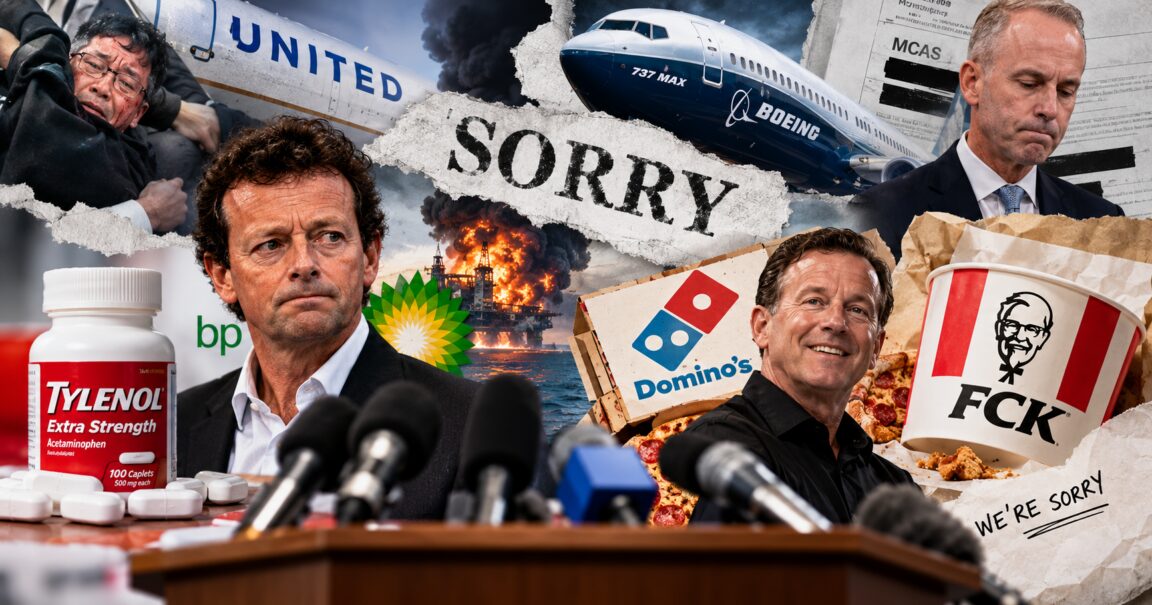
Every one of these started the same way: something went wrong, and someone had to stand in front of the public and explain it. Six moments below, three where it went about as badly as it’s possible to go and three where someone clearly knew what they were doing.
Read them in order and you’ll notice the pattern before I point it out.
The bad
United Airlines, 2017. Dr David Dao got dragged off an overbooked United Express flight by security, and it was filmed by half the plane. United’s first public statement apologised for having to “re-accommodate” customers, which is the kind of phrase that sounds like it was written by the same department that wrote the ticket’s terms and conditions. It took a full week and several increasingly direct apologies from CEO Oscar Munoz before United said anything that sounded like a human being had written it. We’ve gone deeper on this one here.
BP, 2010. Eleven rig workers had died and oil was still pouring into the Gulf of Mexico when CEO Tony Hayward told a reporter, “There’s no one who wants this over more than I do. I’d like my life back.” He apologised for the comment within days, and was gone from the top job by October. It’s one of the most quoted crisis comms mistakes of the last twenty years for a reason: it’s not a lie, it’s just the wrong true thing to say out loud. The full, increasingly worse story is here.
Boeing, 2018 to 2019. Two 737 MAX crashes killed 346 people between them, and Boeing’s initial response to the first one was to assume software updates and better pilot training would fix things, rather than ground the fleet. It took a second crash before regulators grounded the plane worldwide. CEO Dennis Muilenburg was later criticised for being slow and, in the words of reporting at the time, tone deaf towards the victims’ families during two congressional hearings. He was ousted in December 2019. This one’s about concealment more than wording, worth reading in full.
What links all three: nobody said the actually true, actually useful thing quickly enough. Every extra day of hedging made the eventual apology look more like it was extracted rather than offered.
The good
Johnson & Johnson, 1982. Someone laced Tylenol capsules with cyanide and seven people in the Chicago area died, through no fault of J&J’s own systems. Chairman James Burke pulled 31 million bottles nationwide before anyone forced him to, went on 60 Minutes to explain what the company knew, and introduced the tamper proof packaging that’s now standard across the entire industry. Market share collapsed and then mostly recovered within a year. Still the textbook case for a reason. Full detail here.
Domino’s, 2009. This one’s less a crisis and more a company doing something braver than most: admitting their own product was bad before anyone forced them to. Domino’s had fallen to dead last in blind taste tests, and rather than quietly reformulating the recipe and hoping nobody noticed, then-president Patrick Doyle put actual focus group footage of customers trashing the pizza on national television and said it himself, on camera: “there comes a time when you know you’ve gotta make a change.” Same-store sales jumped double digits within a year. It’s the rare case of a company apologising for something before it became a scandal, which is arguably the hardest apology of all to make. Full story here.
KFC, 2018. A botched delivery switch left most of KFC’s UK restaurants without chicken, which should have been a punchline at the company’s expense. Instead KFC ran full page ads with an empty bucket, its logo rearranged to spell “FCK”, and a line admitting a chicken shop without chicken “is not ideal”. No blame passed to the delivery partner, no corporate hedging. Public sentiment towards the brand ended up higher than before the shortage started. More on this one here.
Why the good ones all did the same three things
Take the language out and every good example above did the same three things, in roughly this order: said the true thing fast, took the financial or reputational hit without waiting to be forced into it, and let one identifiable person say it out loud instead of hiding behind a statement from “the company”. The bad examples did the opposite of at least one of those, usually all three.
None of this is really about talent. Burke, Doyle and KFC’s comms team weren’t naturally better talkers than Munoz or Hayward. They’d either been through this before, been trained for it, or had the instincts drilled into them by someone who had. That’s the entire premise behind crisis communication training: the muscle memory for what to say and how fast to say it gets built before the crisis, not during it, because during it there usually isn’t time to figure it out from scratch. There’s more on why speed matters more than most people think, and on the two word answer that makes everything worse, if you want to go further down this particular rabbit hole.
Twenty years of these and the lesson hasn’t changed much. Say the true thing. Say it fast. Say it as a person, not a press release.