 Keith Nallawalla
Every other case in this series is about the wrong words. Boeing’s is about the words nobody outside the company got to hear at all, which turned out to be a much bigger problem.
The two 737 MAX crashes, five months apart
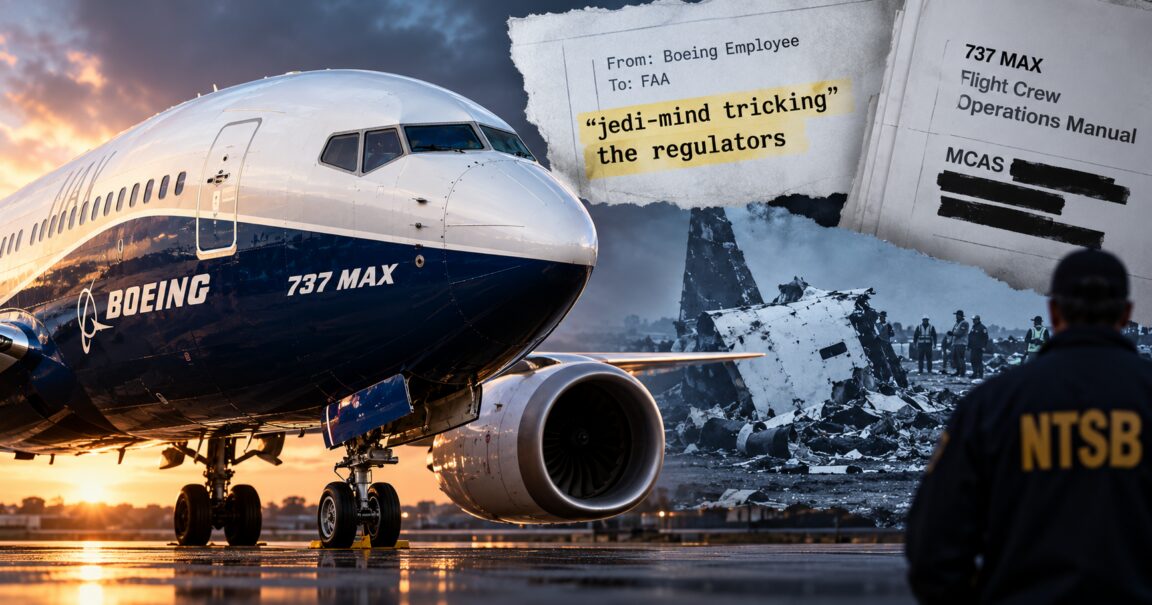
On 29 October 2018, Lion Air Flight 610 crashed into the Java Sea shortly after takeoff, killing 189 people. Boeing’s public response focused on pilot training and treated the incident as isolated. It wasn’t grounded. On 10 March 2019, Ethiopian Airlines Flight 302 went down in near identical circumstances, killing all 157 people on board. Only then did regulators worldwide ground the 737 MAX fleet. Both crashes were later linked to the same automated flight control system, known as MCAS, designed to push the plane’s nose down under certain conditions using a single sensor with no built-in backup.
What Boeing actually knew
The part that separates this from an ordinary product failure came out later, in the Department of Justice’s own investigation. Boeing’s own test pilots had raised concerns about MCAS’s behaviour years before the crashes. One senior pilot, in messages later obtained by investigators, told the FAA to remove references to the system from pilot manuals altogether and privately boasted about “jedi-mind tricking” regulators into approving the training material without it. Pilots flying the plane commercially were never told the system existed, which meant that when it activated unexpectedly on both doomed flights, the crews were fighting a problem they didn’t know they had.
The reckoning, twice
In January 2021, Boeing agreed to pay $2.5 billion to settle a federal charge of conspiracy to defraud the United States: a $243.6 million fine, $1.77 billion to compensate the airlines that had grounded planes sitting unused, and $500 million for the victims’ families. The company admitted its own employees had deceived the FAA. CEO Dennis Muilenburg had already been forced out in December 2019, after congressional hearings where senators accused him of stonewalling. Senator Tammy Duckworth told him directly: “You have told me half-truths over and over again.” That should have closed the file. It didn’t. In 2024, the Justice Department found Boeing had failed to hold up its end of that original settlement, having never properly built the compliance programme it promised, and reopened the door to prosecution. A second financial resolution, worth over $1.1 billion, followed in 2025.
Why hiding it made everything worse
Compare this with almost any other case in this collection and the difference is stark. A bad apology costs you a bad news cycle. Concealing a known safety problem from the regulator responsible for catching it turns a bad news cycle into a federal fraud case, then a second one when the first settlement doesn’t stick. Boeing’s failure wasn’t a spokesperson reaching for the wrong word under pressure, the way United’s did. It was a decision, made well before any cameras were involved, that the easier path was to manage what regulators knew rather than fix what pilots didn’t. Silence and concealment aren’t quite the same fault as a bad statement, but they rhyme: both bet that nobody will find out how much you actually knew, and both lose that bet eventually.
There’s more on how the honesty side of this equation plays out elsewhere in [the wider roundup [LINK: The best and worst corporate apologies of the last 20 years]], if you haven’t already read it.